The City of Lapu-Lapu is named after the first Filipino fighter who successfully defeated the Spanish invaders in the Battle at Barangay Mactan, which was fatal to the Spanish Leader, Magellan. Composed of nineteen (19) barangays in the mainland and eleven (11) barangays in Olango Island, The City of Lapu-Lapu (formerly the Municipality of Opon ) created under R.A. 3134 as The City of Lapu-Lapu on June 17, 1961 and became a Highly Urbanized-City through a plesbiscite on June 21, 2007.
.The existence of two (2) bridges has impressed the accessibility between The City of Lapu-Lapu and other areas in the Province of Cebu which has cut down on transportation expenses as well as travelling time. The City is separated from the province of Cebu by the Mactan Channel, however, at present it is connected with the Province of Cebu by two (2) bridges, known as the 1st Mandaue – Mactan Bridge and Marcelo H. Fernan Bridge. The City of Lapu-Lapu and Municipality of Cordova comprises the whole Mactan Island.
These are connected by two (2) bridges, bound from Suba-Basbas, the Suba-Basbas-Gabi bridge and bound from Babag, the Babag-Pilipog bridge. Her proximity to a highly developed area which is Cebu City has resulted in a mutually reinforcing relationship. The City of Lapu-Lapu utilizes some of the facilities of Cebu City in the field of education (undergraduate and graduate studies) and communications (television, radio and newspaper).
The Metro Cebu Water District (MCWD) has included The City of Lapu-Lapu in its distribution of water supply. It is the seat of Mactan-Cebu International Airport and considered as the gateway to the Pacific, on the other hand, Cebu City and the rest of Metro Cebu make use of the Airport for domestic and international air travel. The airport is a vital international gateway to the country’s economic prosperity and is the country’s second busiest airport.
VISION
By the year 2030, City of Lapu-Lapu shall be a premiere gateway and global haven for tourism and investment with dynamic and healthy people geared towards competitive and business friendly economy, livable, resilient and sustainable environment governed by innovative, professional and competent leaders.
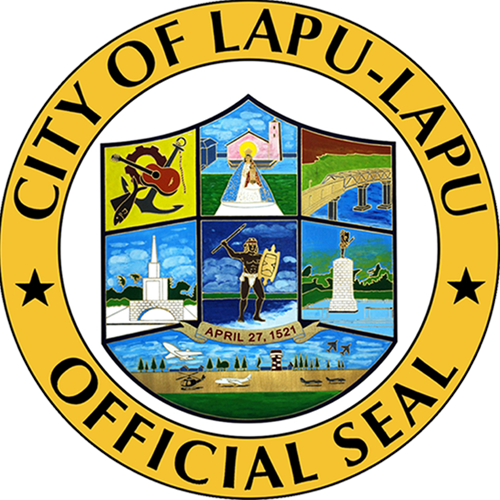
Top Middle - image of the Virgin of the Rule the Patron Saint of the City.
Top Left - indicates that the city is the center of guitar-making through-out the country; also indicates the abundance of marine products.
Top Right - the bridge linking the island-city to mainland Cebu thru Mandaue City.
Center - depicts the defeat of Magellan by Lapu-Lapu on April 27, 1521.
Center Right - monument of Lapu-Lapu
Center Left - monument of Magellan
Lower Portion - alternate internation airport